A 236-million-year-old fossil challenges the story of mammalian live birth
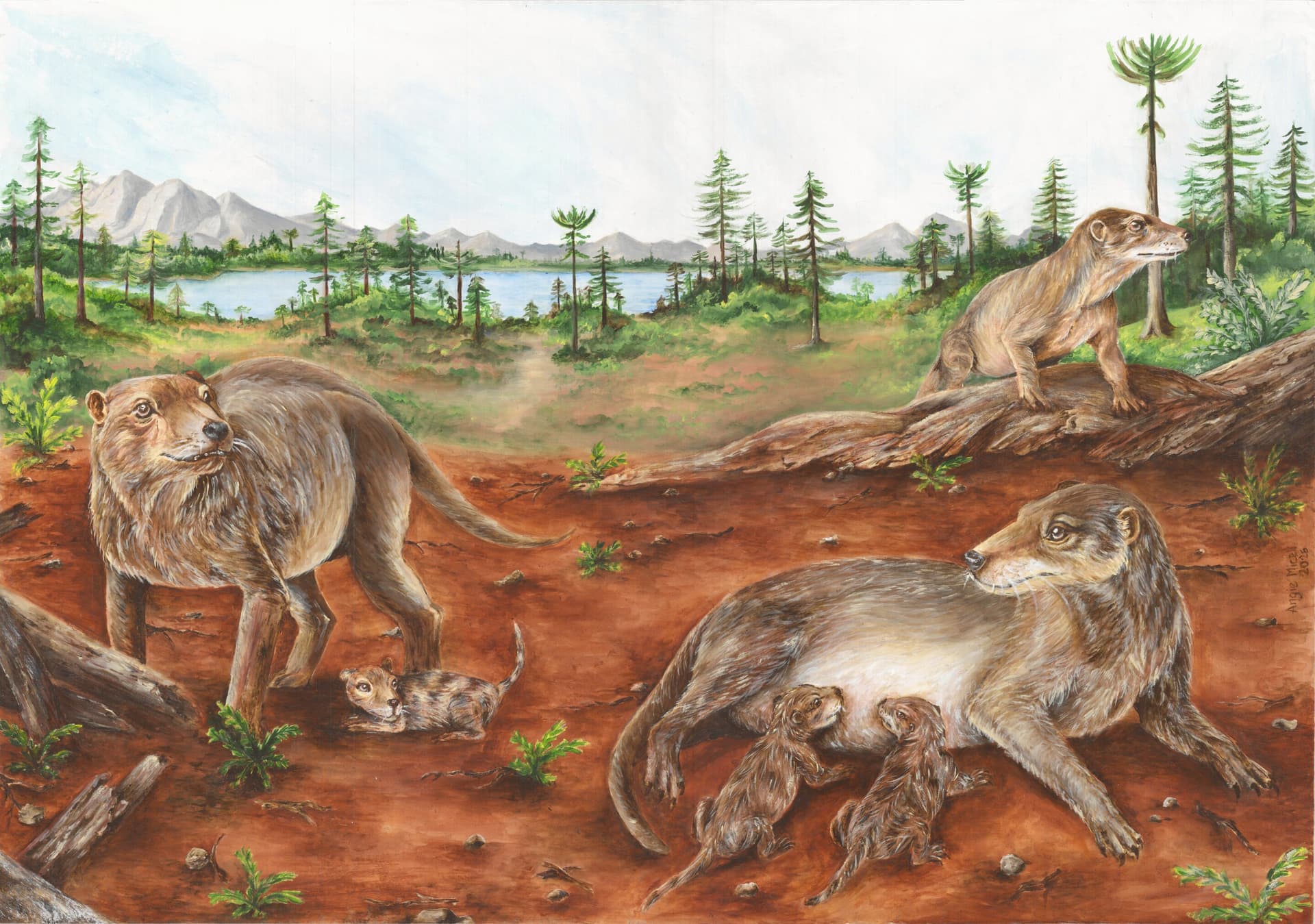

Some cynodonts may have been giving birth to live young much sooner in evolutionary history than previously assumed. A new Frontiers in Mammal Science study has offered the first compelling evidence that cynodonts may have been viviparous—a reproductive mode characterized by live birth.
"We show for the first time that live birth was present in at least one mammalian ancestor, Chiniquodon theotonicus, which lived approximately 236 million years ago," said lead author Dr. Leandro Gaetano, a paleontologist at the National Scientific and Technical Research Council (CONICET) in Argentina.
"This implies that viviparity among early cynodonts originated in the mammalian lineage at least 95 to 90 million years earlier than previously thought."
An inscrutable mystery
"Cynodonts thrived in the Triassic, a period of recovery and restructuring of ecosystems after one of the most devastating mass extinctions in life history," explained senior author Adriana Mancuso, a researcher at CONICET who focuses on the evolution of terrestrial ecosystems.
"This meant high competition for resources and strong predatory pressures. Combined with a trend toward aridity and strong seasonality, embryos of viviparous species would be better protected than those of egg-laying species."

The current study began during a postgraduate course when a growth mark was discovered in the bone microstructure of a fully grown C. theotonicus specimen found in northwestern Argentina. Data from living species suggested it was a neonatal line, a distinct growth ring that can be found in bones or teeth. It's the result of the strong acceleration in growth rate that occurs just after birth.
To test their hypothesis, the team evaluated neonatal body mass relative to adult body mass and compared the values of C. theotonicus with those of several thousand mammals, nonavian reptiles and birds alive today.
"If mammalian ancestors were egg-laying or viviparous has been considered an inscrutable mystery," said Gaetano. "We came up with a somewhat ingenious set of methods to get at something very difficult to analyze in the fossil record."
Big babies
The size and weight of the C. theotonicus specimen at the time of its birth and death were estimated from measurements of its bones. This was done by measuring the neonatal line and the external surface, respectively. The team determined it weighed around 1.7 kg (3.7 pounds) at birth and around 12 kg (26 pounds) when it died. This means the newborn C. theotonicus weighed around 14% of the mass it would have reached by the time of its death.

Living reptiles, like some turtles, snakes and crocodilians, that weigh between 8 kg (18 pounds) and 14.5 kg (32 pounds) produce hatchlings weighing between 9 g (0.3 ounces) and 53 g (1.9 ounces), which translates to very low neonatal-adult body mass ratios of roughly 0.1% to 0.6%.
Birds like some cranes, pelicans or vultures that weigh between 8 kg (18 pounds) and 21.5 kg (47 pounds) produce hatchlings weighing between 110 g (3.9 ounces) and around 357 g (12.6 ounces), a neonatal-adult body mass ratio of around 1.3% to 4.5%.
When it comes to mammals of comparable size, weighing between 8 kg (18 pounds) and 15 kg (33 pounds), newborns can be much heavier, at between 35.5 g (1.3 ounces) and 1.87 kg (4.1 pounds), resulting in neonatal-adult body mass ratios as high as 18.77%. The bay duiker antelope, for example, gives birth to young that weigh about as much as the newborn C. theotonicus.
These calculations exclude nonplacental mammals that lay eggs or harbor their newborns in belly pouches and produce extremely small young.
"We were amazed to find that C. theotonicus grouped with extant placental mammals, being clearly distinct from other amniotes like reptiles or birds," said Gaetano.
Turning a theory on its head
"In cynodonts, embryonic tissues were never observed before, let alone a neonatal line," said co-author María Miceli Baro, a graduate student at the University of Buenos Aires. "Through its analysis, we found that a trait that is generally linked to evolutionary success was present in animals long before true mammals originated."

Until now, giving birth to live young was considered a relatively modern evolutionary acquisition in the mammalian lineage. The finding raises questions about which other traits believed to have appeared much later were already present among cynodonts, the team said.
"It is very well possible that C. theotonicus does not represent an isolated case of viviparity among cynodonts. It could be evidence of the general switch from laying eggs to giving birth to live young early on in the mammalian lineage. But we need more evidence to test this hypothesis," concluded Gaetano. "Still, it looks like some cynodonts were in fact very similar to present-day mammals."
More informationEarly Origin of Viviparity in the Mammalian Lineage, Frontiers in Mammal Science (2026). DOI: 10.3389/fmamm.2026.1845319
Citation: A 236-million-year-old fossil challenges the story of mammalian live birth (2026, August 13) retrieved 13 August 2026 from https://phys.org/news/2026-08-million-year-fossil-story-mammalian.html
This document is subject to copyright. Apart from any fair dealing for the purpose of private study or research, no part may be reproduced without the written permission. The content is provided for information purposes only.
Reporting from Phys.org contributed to this story.