African grasslands expanded 5 million year earlier than previously thought, molecular fossils suggest
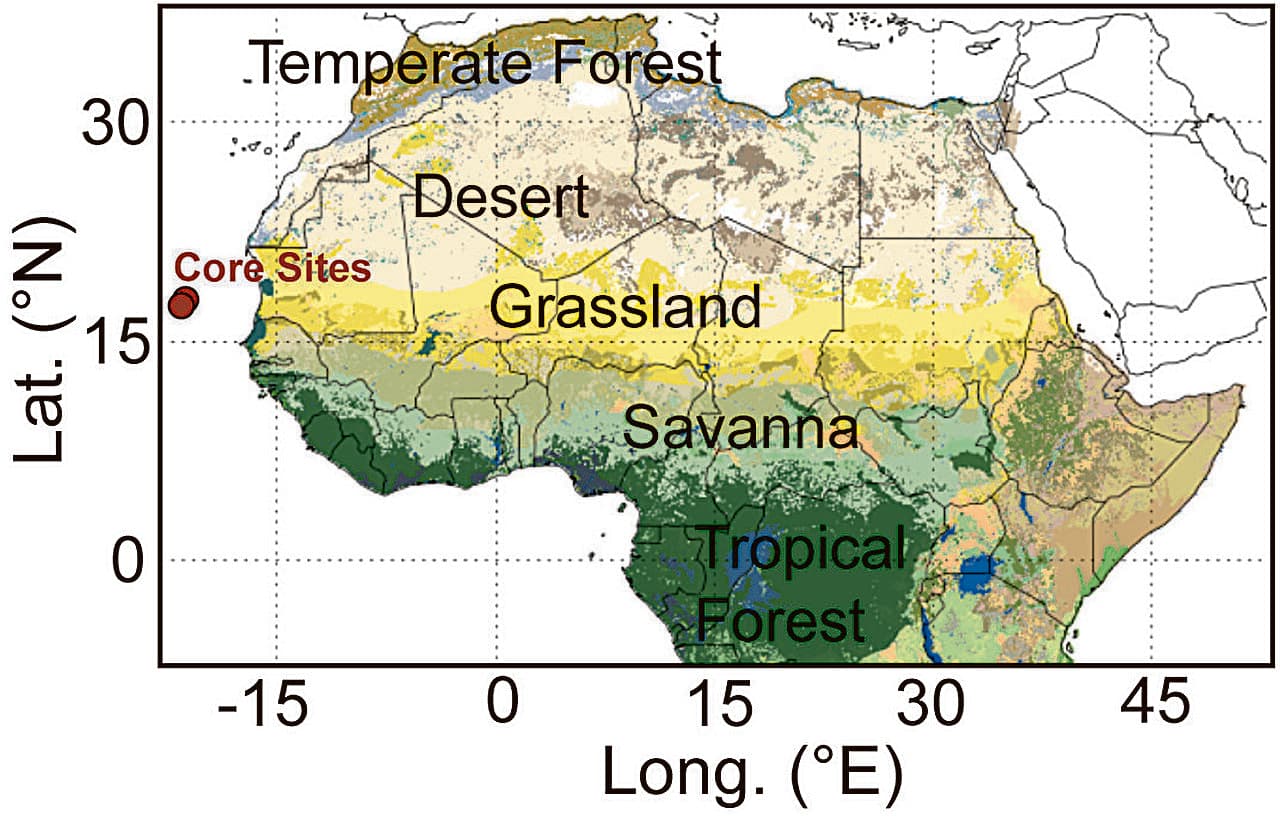

The iconic grassland savannas of Africa are geographically extensive and important for both local fauna and the global climate. But where did they come from, and how will they change in the future? Ongoing warming, rising CO2 levels and shifting rainfall patterns are likely to profoundly change these ecosystems. These effects are difficult to predict because they can alter ecosystems in competing ways.
A study in Proceedings of the National Academy of Sciences investigates the transformation of northwest African ecosystems over the past 24 million years, using molecular fossils and their isotopic chemistry to understand their history and allow projections for the future. The molecular fossils are blown from the continent to the ocean, where they can be preserved in ocean sediments.
The research team sampled drill cores from the International Ocean Discovery Program and extracted and measured these fossils to understand when grasslands developed and the possible causes of their rise to prominence over time.
Earlier roots of open grasslands
They found that the first open (grassland) ecosystems occurred approximately 15 million years ago, or about 5 million years earlier than previously thought. These ecosystems differed from today's in the types of grasses present, and it was not until millions of years later that grasslands more similar to our modern savanna became dominant.
The emergence of African grasslands is a hallmark event in global climate and ecosystem change. The development of grassland ecosystems 15 million years ago also set the stage for faunal evolution in Africa that includes our human ancestors. Their establishment 15 million years ago and subsequent transformation occurred during periods of global cooling and aridification, but involved complex interactions among climate, wildfire and herbivores that still operate today.
Past clues to future shifts
The geologic record indicates that the response of savannas and other subtropical open ecosystems to future climate perturbations will depend on the nature and strength of these interactions, in addition to global climate changes.
This research was led by Anna Schartman during her Ph.D. at the University of California, Santa Cruz, in collaboration with her adviser, Ocean Sciences Professor Pratigya Polissar, and Professor Caroline Strömberg at the University of Washington.
Publication detailsAnna K. Schartman et al, The origin and development of the Miocene northwest African savanna, Proceedings of the National Academy of Sciences (2026). DOI: 10.1073/pnas.2527340123
Citation: African grasslands expanded 5 million year earlier than previously thought, molecular fossils suggest (2026, August 12) retrieved 13 August 2026 from https://phys.org/news/2026-08-african-grasslands-million-year-earlier.html
This document is subject to copyright. Apart from any fair dealing for the purpose of private study or research, no part may be reproduced without the written permission. The content is provided for information purposes only.
Reporting from Phys.org contributed to this story.