Models of glacial collapse in Antarctica improve predictions of sea-level rise

With approximately one-third of the world's population living within a day's walk of a coastline, sea-level rise poses a serious global threat. Every centimeter of sea-level rise could displace 1.5 million people, and current estimates range from half a meter (1.6 feet) to 2 meters (6.6 feet) by the end of the 21st century—which means that potentially hundreds of millions of people could be affected. A more reliable prediction of sea-level rise is crucial to prepare coastal infrastructure and communities around the world for these changes.
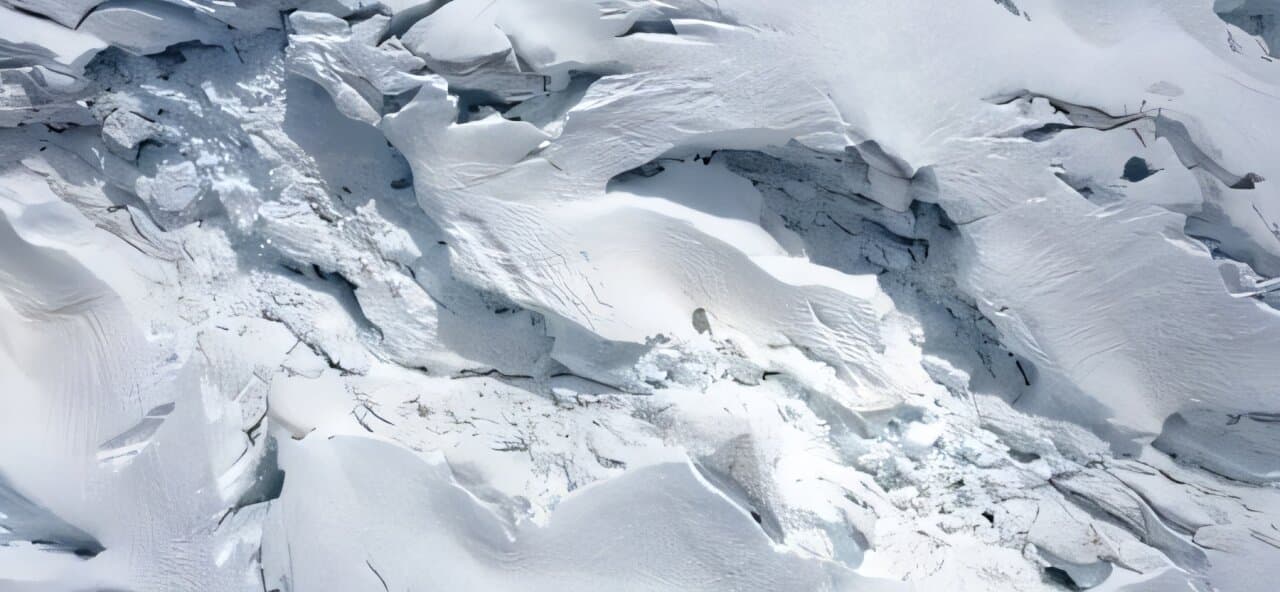
The Pine Island Glacier, located in West Antarctica, is the fastest-flowing glacier on the continent and is the region's largest contributor to sea-level rise. Its steady slide into the ocean is slowed by the Pine Island Ice Shelf, the glacier's floating edge at sea. Ice shelves act like a cork in a bottle, providing what is known as buttressing stress on the heavy body of the glacier to hold back its flow.
In 2017, a large chunk of the Pine Island Ice Shelf broke off into the ocean to form an iceberg in what is called a calving event, and the glacier has since increased its flow speed by 20%. Understanding when and where other ice shelves may calve to form icebergs is critical for predictions of sea-level rise.
In new work, Caltech researchers used nine years of satellite data on the flow of Antarctic glaciers to measure and model how and why ice shelves like Pine Island's collapse.
The study is described in a paper appearing in the journal Proceedings of the National Academy of Sciences on Aug. 11. The work was conducted in the laboratory of Brent Minchew (PhD '16), professor of geophysics.
Damage builds inside the ice
"The potential population displacement caused by sea-level rise is on the order of the displacement seen during World War II, except sustained over entire lifetimes," Minchew says. "That scale of disruption historically comes with conflict. Coastal adaptation is costly, and roughly 90% of people at risk live in low- to mid-income countries. It is critical to understand the future scenario we're facing so that we can most efficiently use resources to prepare."
The behavior of glaciers, which cover thousands of square kilometers and persist for thousands of years, is much more complex than that of ice cubes in a cold drink or ice in the lab, making it challenging to model. Over time, glacial ice accumulates tiny defects in its crystalline structure that add up to create larger damage, like jagged crevasses that can extend hundreds of meters into the ice. Glaciologists aim to understand the exact processes that cause the collapse of such massive, long-lived structures.
"In 2002, the Larsen B ice shelf—which had an area comparable to Rhode Island—in Antarctica collapsed over the course of just six weeks, leading to its glaciers speeding up four- to sixfold," says Sarah Wells-Moran, lead author on the new paper and a former undergraduate and master's student in Minchew's previous lab at MIT. "A lot of the uncertainty in sea-level rise projections comes from our lack of ability to accurately model when these ice shelves are going to collapse because we have gaps in our knowledge of the material properties of ice. How and when does it break? How does it sustain damage?"
The Pine Island Glacier is currently flowing into the sea at a rate of about 4.8 kilometers per year (3 miles per year), about one-hundredth the speed of the average garden snail. Though this seems like a literal "glacial pace," the glacier is currently the largest Antarctic contributor to sea-level rise.
Calving weakened the glacier's brakes
In the new study, the team examined data taken by the European Space Agency's Sentinel-1 radar satellites over Antarctica from 2015 to 2024. The satellites measured the velocity of Pine Island's movement and showed that calving events at the ice shelf, particularly the one in 2017, increased the glacier's velocity by 20%. Overall, the velocity of flow has increased by more than 100% since 1973.
The study also examined the glacier's shear margins, the sides of the glacier where it rubs against rocky Antarctic outcroppings. As with a thick fluid squeezing through a tube, pressure on the sides of the glacier provides an important frictional force to slow its progress. The new study found that calving of the ice shelves at the front edge of the glacier weakened the shear margins at the sides, reducing their ability to hold the glacier back. The data appear to show that the glacier had been completely decoupled from its damaged shear margins by 2020.
"The shear margins have visible damage in them prior to the 2017 calving event," Wells-Moran says. "After this calving event, the damage just intensifies. As the ice speeds up, that puts more force onto the shear margins because the ice is now going faster than the ice next to it, which generates more damage, which further weakens the margin and causes more speedup."
Testing the next phase of retreat
The findings provide a unique opportunity to test models for the retreat of Pine Island Glacier into the ocean. Conventional understanding suggests that Pine Island will undergo a multiyear period of retreat and increased mass loss because of the reduction of buttressing. But the specifics of how and how fast this retreat will occur are unclear. Models used to project sea-level rise need to accurately predict the responses to these changes before they can be trusted to inform coastal planning and adaptation.
"The difference between a future with manageable levels of sea-level rise and the extreme scenarios lies in the behavior of the West Antarctic ice sheet, specifically the evolution of Pine Island Glacier and its neighbor, the Thwaites Glacier," Minchew says. "How these glaciers evolve depends on how their floating ice shelves continue to buttress and resist the seaward flow of ice."
Minchew's group is currently studying possible methods to slow the rate of mass loss and actively stabilize the ice sheets by leveraging the glacier's own natural processes of healing structural defects.
Publication detailsSarah Wells-Moran et al, Near-total loss of buttressing stresses observed on Pine Island Ice Shelf, West Antarctica, Proceedings of the National Academy of Sciences (2026). DOI: 10.1073/pnas.2602994123
Citation: Models of glacial collapse in Antarctica improve predictions of sea-level rise (2026, August 12) retrieved 13 August 2026 from https://phys.org/news/2026-08-glacial-collapse-antarctica-sea.html
This document is subject to copyright. Apart from any fair dealing for the purpose of private study or research, no part may be reproduced without the written permission. The content is provided for information purposes only.
Reporting from Phys.org contributed to this story.