Welsh film lover shares home with life-sized collectibles
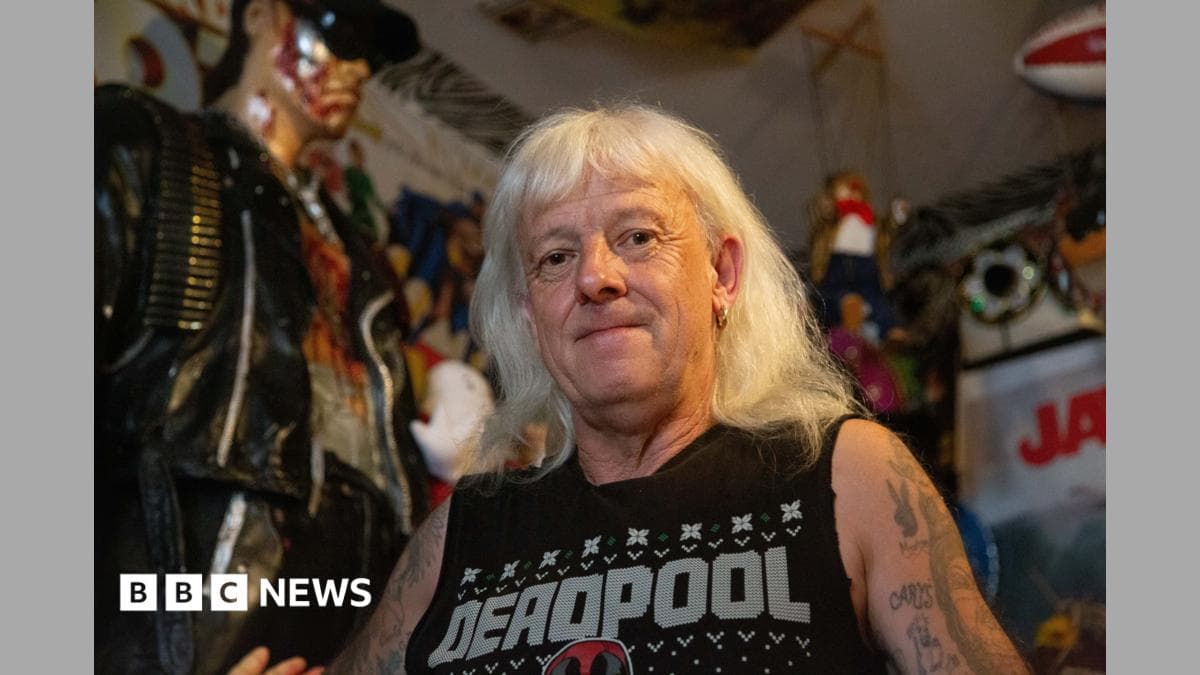
Setting foot into a one-bedroom flat in an old mining village, you immediately become aware of dozens of pairs of eyes staring at you.
"My landlord used to call me Peter Pan," said 61-year-old Martin James, a former cleaner, farmer and singer who now spends much of his time buying, creating and altering his collectables.
He shares his modest-sized flat in Caerphilly county with 32 "life-sized" props, including an imposing T-800 - the Terminator played by Arnold Schwarzenegger.
He also has a 6ft, 175lb (79kg) Po, better known as Kung Fu Panda, and Pennywise, the clown from the film, It.
Overlapping action figures, posters and teddy bears also cover Martin's walls and ceilings. His collectables consist of "anything unusual", but he is mostly inspired by Hollywood.
He's far from alone and is part of a rising cohort of "kidults", who are consumers over the age of 12, who are trying to counter the "doom and gloom" of adult life, an expert said.
"They call me mad Martin and I don't know why," he laughed.
He traded his motorbike for a Terminator figure nearly 10 years ago and said his larger collectables were now increasing in value.
Martin said he was offered £10,000 for his Kung Fu Panda figure, more than the estimated value, but insists it is not about money.
"Christ, no. I'd never do it for the money. People say: 'Why collect then?' It's because I enjoy it.
"Life is too short to be boring, I don't drink, I don't smoke. If I'm going to spend any money, I'd like to show what I got out of it."
Martin's collection is a mix of rare items and props he has created or refined himself.
He says his partner has been "good as gold", helping him collect items, while his own children have grown up, allowing him to dive into his hobby.
"I think the idea of 'childlike passions', for a psychologist, we would probably label that within a broad area of play," said Dr Julie Kirkham, leader for the MSc family and child psychology programme at the University of Chester.
Kirkham places activities such as reading fiction or creative crafts in a similar category, although these might face less stigma than an activity like Lego.
"Although these may seem childlike, they may still have important functions of allowing us to be creative, to reduce stress and take a break from complex cognitive tasks and to develop social relationships and build social bonds.
"I think it's increasingly becoming recognised that adults play as well."
Kirkham also cites play as having "therapeutic value" for exploring our emotions, experiences and memories, but in a safe space.
"But it could also just be fun, sometimes it isn't any more complicated than that."
She said the pandemic created conditions for increased interest in activities like collecting.
"Humans are a very social species, so interacting via social media offered opportunities to alleviate boredom and join communities and develop friendships."
For Martin, collecting gives him a sense of meaning: "I've had a few tragedies in my life through family and whatever else, and I think, 'enjoy life while it's here'."
Reporting from BBC News contributed to this story.


